

The 2026 FIFA World Cup runs from June 11 to July 19, hosted across the United States, Canada, and Mexico, the first three-country tournament in the sport’s history and the first World Cup with a 48-team expanded field. Over five weeks, you will watch dozens of matches.
In between them, you’ll want films. The 16 movies below are the ones worth watching during a World Cup, organized into four viewing modes (comedy, rise narrative, international perspective, and documentary) so you can match tonight’s film to tonight’s tournament mood. Every film has been checked for streaming availability. Every film has a specific World Cup connection.
This piece runs on a simple idea: soccer cinema sorts itself into four recognizable registers, and knowing which register you’re in the mood for is more useful than a flat, undifferentiated ranking.
The Four Modes of Soccer Cinema, comedy, rise narrative, international perspective, and documentary, organize the 16 films below. Together they span 43 years, from Escape to Victory in 1981 to The Beautiful Game in 2024, and eight countries of production. Every entry names the specific tournament window, a group stage evening, an off-day, the day after your team goes out, when it fits best. Further down, a section on TV honorable mentions covers Ted Lasso Season 4, Welcome to Wrexham, The English Game, and Dear England, the shows that would have swelled this list if it covered television as well as film.
Jump to the film-by-film breakdowns below, or skip straight to the viewing calendar for a tournament-by-tournament guide.
Why Soccer Cinema Matters During the 2026 World Cup
Every World Cup produces a spike of interest in soccer cinema. This one will produce more than most. The tournament is being hosted in three countries, the United States, Canada, and Mexico, whose combined soccer fan bases have historically been under-served by soccer film distribution. Access is easier than ever: streaming platforms have quietly built one of the deepest soccer libraries in cinema history. And the sport itself is in an unusual cultural moment.
The North American moment
For the first time, the World Cup is being co-hosted by three countries with unusually different soccer cultures. Mexico’s football tradition dates to the 1930 tournament, and the country previously hosted in 1970 and 1986. The United States has spent a generation building professional infrastructure and now runs the sport’s fastest-growing top-tier league, Major League Soccer, alongside an increasingly loud NWSL. Canada is the newest of the three to top-tier tournament football and hosts the fewest matches, but the cultural investment is real. The films on this list, many of them British and European in origin, arrive in North American feeds with fresh urgency simply because the tournament is happening in viewers’ own backyards this summer.
The streaming acceleration
Ten years ago, watching Diego Maradona (2019) or Copa 71 (2023) meant a festival trip or a Blu-ray import. As of July 2026, both are one click away. The Damned United (2009) streams free on The Roku Channel. Offside (2006) is also free there. The Beautiful Game (2024) sits on Netflix. The infrastructure that makes a curation piece like this one useful is a genuine achievement of the past decade: streaming platforms have quietly assembled one of the deepest soccer-cinema libraries in film history, and most of it is now a search bar away rather than a specialty-store errand.
The Ted Lasso factor, with a timing correction
Ted Lasso Season 4 is real and confirmed, but it lands after this World Cup closes rather than during it. Apple TV+ has set the premiere for August 5, 2026, more than two weeks after the July 19 final at MetLife Stadium, with new episodes airing weekly through October 7. That makes Ted Lasso less a World Cup companion piece and more a landing pad for the football appetite the tournament will have built. The show also returns changed: Season 4 follows Ted coaching a second-division women’s football team rather than picking up directly with AFC Richmond’s men’s side, and Jamie Tartt actor Phil Dunster will not appear this season due to a scheduling conflict. The optimism-plus-earnestness register that made the original three seasons a comfort watch is still the throughline, and it is worth flagging here even though, strictly, it falls outside the tournament’s own calendar.
The Four Modes of Soccer Cinema
Sixteen films is a lot to browse without a plan. The framework below organizes the list into four viewing modes, each one built for a different kind of tournament night. Match your evening to the mode, then match the mode to the film.
Mode 1: The Comedy Kick
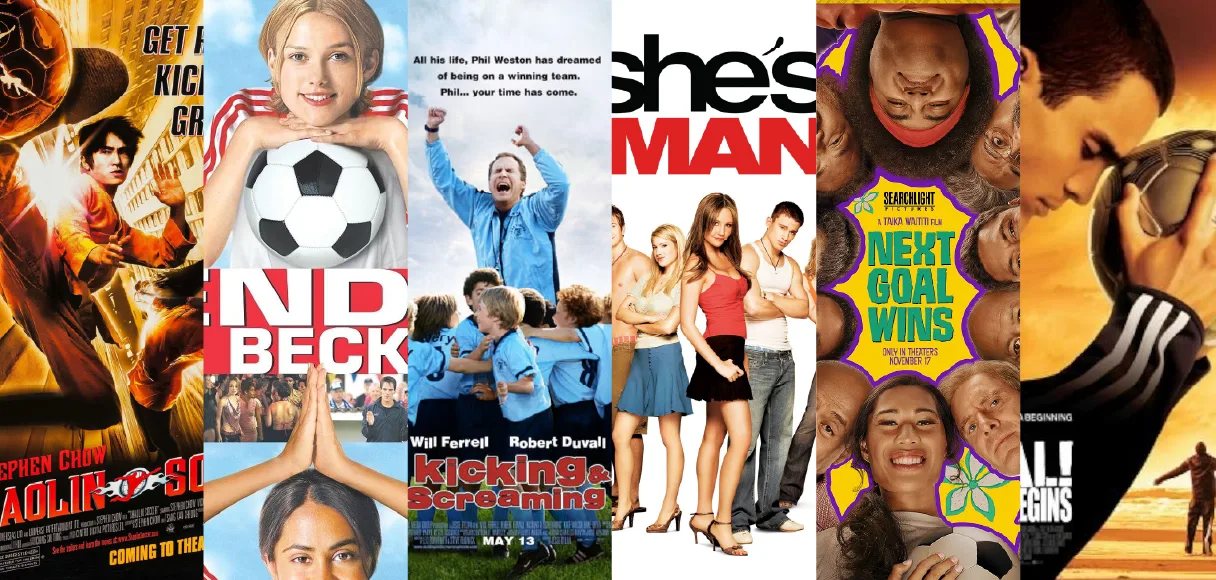
Mode 1 is broad, feel-good soccer comedy built for family viewing, group watch parties, and the off-day between big matches. Bend It Like Beckham (2002) is the mode’s clearest example, a cross-cultural comedy that broke international box office records for a British indie. Shaolin Soccer (2001), She’s the Man (2006), Kicking & Screaming (2005), and Next Goal Wins (2023) round out the mode. Reach for Mode 1 when the room has more than one person in it and the vibe is celebratory rather than intense.
Mode 2: The Rise Narrative
Mode 2 is prestige football drama and underdog cinema, where the stakes are serious and the emotional payoff is earned rather than handed over. The Damned United (2009), Tom Hooper’s Brian Clough biopic starring Michael Sheen, is the mode’s peak. Escape to Victory (1981), with Pelé, Bobby Moore, and Sylvester Stallone, is the mode’s canonical war-and-football drama. Goal! The Dream Begins (2005), Green Street Hooligans (2005), and The Beautiful Game (2024) round out the mode. Pick Mode 2 when the tournament has already raised your emotional intensity and you want a film that matches it.
Mode 3: The World View
Mode 3 is international cinema that uses soccer as a lens on society, gender, or political circumstance rather than as a genre unto itself. Offside (2006), Jafar Panahi’s film about Iranian women trying to sneak into a World Cup qualifier, is the mode’s most-cited example, a 96 percent critical approval film widely considered one of the best soccer films of the century. The Miracle of Bern (2003) chronicles West Germany’s 1954 World Cup victory and the country’s post-war identity. Reach for Mode 3 when you want the world’s game to actually feel like the world’s game.
Mode 4: The Real Story
Mode 4 is documentary, the form soccer has always been friendly to because the sport’s history is so richly archived. The Two Escobars (2010) is a 30 for 30 masterpiece about Andrés Escobar, Pablo Escobar, and the entangled tragedy of Colombian football in the 1990s. Diego Maradona (2019) is Asif Kapadia’s third archival-material feature, following Amy and Senna. Zidane: A 21st Century Portrait (2006) and Copa 71 (2023) round out the mode. Pick Mode 4 when the halftime broadcast has left you wanting more analysis, not less.
The 16 Films at a Glance
A scannable index before the full breakdowns. Streaming platforms shift constantly and should be re-checked against JustWatch at the time of reading; the notes below reflect availability as verified in July 2026.
| Film | Year | Director | Country | Critical approval | Mode |
| Shaolin Soccer | 2001 | Stephen Chow | Hong Kong | 89% | Comedy Kick |
| Bend It Like Beckham | 2002 | Gurinder Chadha | UK | 85% | Comedy Kick |
| Kicking & Screaming | 2005 | Jesse Dylan | USA | 42% | Comedy Kick |
| She’s the Man | 2006 | Andy Fickman | USA | 44% / 78% | Comedy Kick |
| Next Goal Wins | 2023 | Taika Waititi | USA/UK | 46% / 84% | Comedy Kick |
| Escape to Victory | 1981 | John Huston | USA/UK | 55% / 74% | Rise Narrative |
| Goal! The Dream Begins | 2005 | Danny Cannon | UK | 55% / 70% | Rise Narrative |
| Green Street Hooligans | 2005 | Lexi Alexander | UK | 51% / 84% | Rise Narrative |
| The Damned United | 2009 | Tom Hooper | UK | 92% / 84% | Rise Narrative |
| The Beautiful Game | 2024 | Thea Sharrock | UK | 80% / 89% | Rise Narrative |
| The Miracle of Bern | 2003 | Sönke Wortmann | Germany | 91% / 88% | World View |
| Offside | 2006 | Jafar Panahi | Iran | 96% / 89% | World View |
| Zidane: A 21st Century Portrait | 2006 | Gordon / Parreno | France/UK | 79% / 66% | Real Story |
| The Two Escobars | 2010 | Zimbalist brothers | USA | 100% / 96% | Real Story |
| Diego Maradona | 2019 | Asif Kapadia | UK | 95% / 84% | Real Story |
| Copa 71 | 2023 | Ramsay / Erskine | UK | 100% / 94% | Real Story |
Mode 1: The Comedy Kick, 5 Feel-Good Soccer Comedies
The five films below are broad-appeal soccer comedies that work whether the viewer knows the offside rule or not. They’re the mode to reach for on off-days between matches, for family watch parties, or for any tournament evening when the vibe is celebratory rather than intense. Presented in chronological order.
1. Shaolin Soccer (2001)
Director: Stephen Chow
Country: Hong Kong
Runtime: 87 minutes
Critical approval: 89%
Where to watch: Free with ads on Tubi and Kanopy; also on Paramount+ (various tiers), fuboTV, YouTube TV. Rent on Amazon, Apple TV, Fandango at Home.
The pitch: A former Shaolin monk, played by Chow, assembles a team of his kung fu-trained brothers to conquer the world of soccer, with each brother deploying a distinct martial arts specialty on the pitch.
Why it belongs in this mode: Shaolin Soccer is the mode’s most globally cited comedy, a Stephen Chow classic that grossed more than 40 million dollars worldwide and became one of the highest-grossing Hong Kong films ever made. Its genre fusion of comedy, martial arts, and sports is the exact register this mode was built around, and it rewards viewers who don’t need their soccer to look realistic.
The World Cup connection: The film’s premise, a rag-tag team using unconventional skills to win a national trophy, parallels the underdog runs every World Cup produces somewhere in the bracket.
Watch during: Group watch parties, family viewing, or any off-day.
The Screendollars Take: Shaolin Soccer is not really a sports movie. It is a Stephen Chow cartoon that happens to use a pitch, where the ball leaves scorch marks and the keeper channels Bruce Lee. The joke is that it takes winning completely seriously and nothing else seriously at all. Reach for it when the tournament’s self-importance needs puncturing.
2. Bend It Like Beckham (2002)
Director: Gurinder Chadha
Country: UK
Runtime: 112 minutes
Critical approval: 85%
Where to watch: Streaming on Disney+, Hulu, and free with ads on Tubi. Rent on Amazon, Apple TV, Fandango at Home.
The pitch: An 18-year-old British-Indian girl, played by Parminder Nagra, hides her love of football from her traditional Sikh family and joins a local women’s team led by an ambitious coach played by Jonathan Rhys Meyers. Keira Knightley co-stars.
Why it belongs in this mode: Bend It Like Beckham is the mode’s canonical film, one of the most commercially successful British independent soccer films ever made, grossing more than 76 million dollars globally on a 6 million dollar budget. Its cultural specificity, British-Indian identity set against women’s football in the early 2000s, is the register’s structural strength, and nearly every culturally-crossover soccer comedy since owes it something.
The World Cup connection: The rise of the Women’s World Cup as a genuine global draw, following 2023’s record-breaking edition and the 2027 tournament announcement, has made the film’s women’s-football throughline more relevant than at any point since its release.
Watch during: A group viewing party, especially one that includes viewers new to soccer culture.
The Screendollars Take: Bend It Like Beckham is not a soccer movie with a family drama attached. It is a film about who gets permission to want something, with the pitch as the one place Jess is allowed to be fully herself. Chadha lets two things stay true at once: her family’s fears are real, and so is her talent. It out-earned its budget more than a hundred to one because that tension is universal.
3. Kicking & Screaming (2005)
Director: Jesse Dylan
Country: USA
Runtime: 95 minutes
Critical approval: 42%
Where to watch: No subscription or free option right now. Rent/buy only, on Amazon, Apple TV, Fandango at Home.
The pitch: A meek family man, played by Will Ferrell, takes over as coach of his son’s terrible youth soccer team and spirals into a wildly competitive parent, clashing with his own ultra-competitive father, played by Robert Duvall.
Why it belongs in this mode: Kicking & Screaming is the mode’s American family-comedy anchor. Critical reception was mixed at 42 percent on critical approval, but its rewatchability among American families with kids in youth soccer is real and durable. Ferrell works in full Ferrell mode here, and Duvall’s rare late-career comedic turn gives the film more texture than it’s usually credited for.
The World Cup connection: With the 2026 tournament unfolding on American soil, the film’s specifically American youth-soccer setting resonates with the millions of parents whose kids are watching the World Cup for the first time this summer.
Watch during: Family Sunday viewing, or right after your own kid’s weekend match.
The Screendollars Take: Kicking & Screaming is not about youth soccer. It is about a grown man’s issues with his father, played out on a field full of ten-year-olds who never signed up for it. Ferrell’s mild dad curdling into his own competitive father is the whole engine. It is minor, but it knows exactly what the suburban sideline is really like.
4. She’s the Man (2006)
Director: Andy Fickman
Country: USA
Runtime: 105 minutes
Critical approval: 44% critics / 78% audience
Where to watch: Streaming on Prime Video (standard or with ads), plus subscription access via Kanopy/Hoopla (library card apps). Rent/buy on Apple TV, Fandango at Home.
The pitch: A high school soccer player, played by Amanda Bynes, disguises herself as her twin brother to join his boarding school’s team after her own school cuts the girls’ program. Channing Tatum stars in his breakout role. The film loosely adapts Shakespeare’s Twelfth Night.
Why it belongs in this mode: She’s the Man is the mode’s teen-comedy cornerstone. Critics were unkind at release, but audience reappraisal has been strong, and the film has settled into place as a truly rewatchable relic of 2000s teen cinema. Bynes carries the film, and Tatum’s early charisma is doing more work here than the premise strictly requires.
The World Cup connection: The film’s gender-specific soccer politics, a girls’ team cut, girls forced to compete in a boys’ league, echo the real pay-equity disputes the U.S. women’s national team resolved in 2023 and the broader conversations that will surround women’s football throughout this tournament.
Watch during: Off-day comfort viewing, or a group party mixing soccer novices with casual fans.
The Screendollars Take: She’s the Man is not a soccer movie, it is Twelfth Night with shin guards, and it commits to the disguise harder than it has any right to. Bynes plays the entire farce at a full sprint, and the real subject underneath is a girl proving she belongs on a field that told her she did not. The conviction is real even when the plot is ridiculous, which is why it still holds up.
5. Next Goal Wins (2023)
Director: Taika Waititi
Country: USA/UK
Runtime: 104 minutes
Critical approval: 46% critics / 84% audience
Where to watch: It’s rent/buy only now, on Amazon, Apple TV, Fandango at Home.
The pitch: A disgraced professional soccer coach, played by Michael Fassbender, is sent to coach the American Samoa national team, then the worst side in international football after a 31-0 loss to Australia in 2001, in their bid to qualify for the 2014 World Cup. The film adapts the 2014 documentary of the same name.
Why it belongs in this mode: Next Goal Wins is the mode’s most recent major release. Taika Waititi’s tonal signature, feel-good underdog comedy with genuine cultural specificity, is exactly what this mode asks for. Critics were split, but audiences responded strongly to the humor and the Polynesian-culture texture Waititi brings to the material.
The World Cup connection: The film’s story of a team fighting simply to qualify sits in direct contrast to watching a top-tier nation compete for the trophy itself, and the juxtaposition makes for surprisingly good companion viewing.
Watch during: An off-day, especially with viewers who love a genuine underdog story.
The Screendollars Take: Next Goal Wins is not an underdog story about winning. It is about a team learning that not losing 31-nil is its own kind of victory. Waititi keeps undercutting the inspirational beats with real cultural specificity, so Jaiyah matters as much as the scoreline. The small stakes are the point: sometimes a single goal is the whole dream.
Mode 2: The Rise Narrative, 5 Serious Soccer Dramas
The five films below are prestige football dramas: underdog rises, historical crises, and character studies where the stakes are serious and the emotional payoff is earned. Watch these when the tournament has already raised your emotional intensity and you want a film that matches it. Presented in chronological order.
6. Escape to Victory (1981)
Director: John Huston
Country: USA/UK
Runtime: 116 minutes
Critical approval: 55% critics / 74% audience
Where to watch: Streaming via Kanopy (library card). Otherwise rent/buy only, on Prime Video, Apple TV, Fandango at Home.
The pitch: Allied POWs during World War II are recruited by their German captors to play an exhibition match in Paris, and plan their escape at halftime. Sylvester Stallone plays goalkeeper, Michael Caine is team captain, and real footballers including Pelé, Bobby Moore, and Ossie Ardiles play themselves.
Why it belongs in this mode: Escape to Victory is the mode’s canonical war-and-football drama. Huston’s direction, a cast that mixes major American stars with actual professional footballers, and the sheer audacity of the premise, soccer as an escape plan, make it a genuine outlier in the sports-film canon. The Pelé bicycle-kick sequence alone earns the film its place on any list like this one.
The World Cup connection: Its central theme, sport as a form of resistance, resurfaces every World Cup, where geopolitics has a habit of intersecting with the game whether FIFA wants it to or not.
Watch during: The night before your team’s biggest match, or any evening you want a specific, unrepeatable strain of 1970s earnestness.
The Screendollars Take: Escape to Victory is not a good war movie, and it barely tries to be. It is an excuse to watch Pelé, Bobby Moore, and Ossie Ardiles play real football inside a POW camp, and it comes alive every second the professionals are on the ball. Stallone in goal is the price of admission. Pelé’s overhead kick is what you actually paid for.
7. Goal! The Dream Begins (2005)
Director: Danny Cannon
Country: UK
Runtime: 118 minutes
Critical approval: 55% critics / 70% audience
Where to watch: Streaming via Disney+. Also rent/buy on Google Play, Fandango at Home.
The pitch: An undocumented Mexican teenager, played by Kuno Becker, working construction in Los Angeles gets an unexpected shot at signing for Newcastle United in England’s Premier League, leaving his family behind despite the cold weather, the culture shock, and his father’s skepticism.
Why it belongs in this mode: Goal! is the mode’s immigration-underdog film, the story of a Latino player’s rise in English football at the exact moment the Premier League was becoming a truly global product. It has quietly built a cult following among a generation of fans who came to the sport through it rather than the reverse.
The World Cup connection: With Mexico co-hosting the 2026 tournament, the film’s arc from Los Angeles construction sites to Newcastle carries new weight, mirroring the transnational journey the tournament itself literally embodies this summer.
Watch during: Before or after a Mexico match, or any evening the tournament has you thinking about the sport’s transnational pull.
The Screendollars Take: Goal! The Dream Begins is not a gritty immigration drama, it is a fairy tale, and it wears that openly. Santiago’s rise from a gardener’s son to Newcastle United is pure wish fulfillment, cleared by the real clubs and stadiums that agreed to play along. It works because it believes its own fantasy completely, which is the only right way to make a film like this.
8. Green Street Hooligans (2005)
Director: Lexi Alexander
Country: UK
Runtime: 109 minutes
Critical approval: 51% critics / 84% audience
Where to watch: Buy-only on DVD/Blu-ray
The pitch: An American journalism student, played by Elijah Wood, expelled from Harvard travels to London and gets pulled into the orbit of West Ham United’s firm, a gang of football hooligans led by a character played by Charlie Hunnam.
Why it belongs in this mode: Green Street Hooligans is the mode’s outlier, a film about football’s fringe culture rather than its mainstream. Critics were unconvinced, but audiences responded strongly, and the film has become a cult favorite for fans drawn to the sport’s darker corners rather than its Sunday-best version.
The World Cup connection: The tournament’s mass-attendance mechanics, packed stadiums and tribal energy, occasionally surface the culture this film dramatizes, and watching it during a World Cup adds real context to what happens outside the stadium gates.
Watch during: A late-night viewing after the day’s matches, when you want something with an edge.
The Screendollars Take: Green Street Hooligans is not about soccer at all, it is about masculinity hunting for a war to fight. Elijah Wood’s expelled American finding belonging in a West Ham firm is the honest hook and also the problem: it romanticizes the violence it means to examine. Watch it for the tribalism the World Cup politely sublimates, and notice how thin the line really is.
9. The Damned United (2009)
Director: Tom Hooper
Country: UK
Runtime: 97 minutes
Critical approval: 92% critics / 84% audience
Where to watch: Streams free with ads on The Roku Channel; also available to rent on Prime Video and Apple TV.
The pitch: The disastrous 44-day reign of brilliant, egotistical English football manager Brian Clough, played by Michael Sheen, at Leeds United in 1974. The film tracks Clough’s obsession with predecessor Don Revie, played by Colm Meaney, and his relationship with assistant Peter Taylor, played by Timothy Spall.
Why it belongs in this mode: The Damned United is the mode’s peak, one of the highest-rated English football films ever made at 92 percent on critical approval. Sheen’s performance as Clough is career-defining, Hooper’s direction is precise, and David Peace’s source material gives the film a sharpness most sports dramas never attempt. This is football treated with the seriousness usually reserved for prestige historical drama.
The World Cup connection: Its central subject, an obsessive, brilliant manager whose personal demons determine his professional fate, parallels the managerial-drama subplot every World Cup generates. This one will have several.
Watch during: An evening you want to feel like you’re watching capital-C Cinema, not just a sports movie.
The Screendollars Take: The Damned United is not really about 44 days at Leeds. It is about a grudge, Brian Clough’s obsession with the man he replaced, and the way ego curdles genius. Sheen plays Clough as a charmer who cannot stop picking the fight he is losing. The football is almost incidental; this is a character study in a tracksuit.
10. The Beautiful Game (2024)
Director: Thea Sharrock
Country: UK
Runtime: 125 minutes
Critical approval: 80% critics / 89% audience
Where to watch: Streaming on Netflix.
The pitch: A once-promising English footballer, played by Micheal Ward, is now homeless. His coach, played by Bill Nighy, invites him to join England’s squad at the Homeless World Cup, a real annual tournament in which the film’s story is set in Rome, with over seventy countries typically taking part.
Why it belongs in this mode: The Beautiful Game is the mode’s most recent entry and one of its best. Sharrock’s direction handles heavy material, addiction, poverty, immigration, without tipping into sentimentality, Nighy’s supporting performance grounds the film, and Ward’s central turn is a legitimate breakout. The film was made with the cooperation of the real Homeless World Cup Foundation, and several actual former participants appear alongside the cast.
The World Cup connection: The real Homeless World Cup has itself moved this year: Mexico City’s 2026 edition has been rescheduled to January 2027, so the tournament won’t run alongside the men’s World Cup after all. What still lands is the contrast the film draws on its own terms, the version of football that exists entirely outside the professional game’s floodlit spectacle, which is worth sitting with during a summer when the sport’s biggest stage is getting all the attention.
Watch during: A quieter evening between big matches, when you want to remember what football is used for beyond the professional game.
The Screendollars Take: The Beautiful Game is not a tournament movie, it is a redemption movie that borrows a tournament to stage it. The Homeless World Cup gives Vinny’s story a real-world frame most feel-good films have to invent, and Bill Nighy anchors the sentiment before it drifts off. It is gentle to a fault, but the thing it is gentle about actually exists.
Mode 3: The World View, 2 International Films That Use Soccer as a Lens
The two films below use soccer as a lens on society, gender, and politics rather than as a genre in itself. Both are non-English-language films that international audiences may have missed. Both belong on any serious soccer cinema list. Presented in chronological order.
11. The Miracle of Bern (2003)
Director: Sönke Wortmann
Country: Germany
Runtime: 118 minutes
Critical approval: 91% critics / 88% audience
Where to watch: DVD import
The pitch: In post-war West Germany, a father returns home from a Soviet prison camp to a country he no longer recognizes and a son who idolizes national football hero Helmut Rahn. As West Germany’s national team approaches the 1954 World Cup Final against Hungary, the family’s reconciliation runs parallel to the country’s own.
Why it belongs in this mode: The Miracle of Bern is the mode’s post-war national-identity film. West Germany’s 1954 World Cup victory over Hungary is widely credited with helping restart the country’s national confidence after the war. Wortmann’s direction carries that historical weight without turning solemn, and the family drama at the film’s center gives the larger historical arc somewhere to land emotionally.
The World Cup connection: Every World Cup produces at least one moment where a result seems to rearrange a nation’s sense of itself. The Miracle of Bern is the film about that phenomenon at its most historically consequential.
Watch during: Before or after Germany plays, or any evening you want to see how soccer can truly restart a country’s self-image.
The Screendollars Take: The Miracle of Bern is not a sports film, it is a film about a country using a football result to begin forgiving itself. Wortmann threads the 1954 final through a father returning from a Soviet POW camp to a son who does not know him, so the match becomes a whole nation’s second chance. It is the clearest case here of soccer carrying a weight far heavier than a trophy.
12. Offside (2006)
Director: Jafar Panahi
Country: Iran
Runtime: 93 minutes
Critical approval: 96% critics / 89% audience
Where to watch: Streams free with ads on The Roku Channel; Also rent/buy on Amazon, Apple TV, Fandango at Home.
The pitch: Iranian women are banned from attending football matches. A group of young women disguise themselves as men to sneak into Iran’s World Cup qualifier against Bahrain in Tehran. Panahi shot the film during an actual match, so much of what you see blends documentary reality with staged drama.
Why it belongs in this mode: Offside is the mode’s clearest statement, a 96 percent critical approval film widely considered one of the best soccer films of the twenty-first century. Panahi’s direction, made by a filmmaker later placed under house arrest for subsequent work, uses the specific circumstances of Iranian women’s exclusion to build a broader argument about who football actually belongs to.
The World Cup connection: Iran will feature in the 2026 tournament. Every match Iran plays this summer is a match Iranian women are still, in 2026, banned from attending inside their own country, which means the political specificity Offside dramatizes has not gone anywhere.
Watch during: Before or after any Iran match, or any evening you want a reminder that the sport carries stakes beyond the scoreline.
The Screendollars Take: Offside is not a film about football, it is a film about a locked door, shot in near real time outside a stadium women are banned from entering. Panahi turns one afternoon into a precise, funny, furious argument about who is allowed to belong. That he filmed it during the actual qualifier, and was later barred from making films, is part of the text now.
Mode 4: The Real Story, 4 Documentaries Every Football Sicko Needs
The four films below are documentaries. Soccer has always been friendly to the documentary form because the sport’s history is so richly archived; every match has been recorded, and every legendary player has left footage behind. The four here range from an ESPN 30 for 30 masterpiece to an experimental art project to a landmark work of women’s-football history. Presented in chronological order.
13. Zidane: A 21st Century Portrait (2006)
Director: Douglas Gordon and Philippe Parreno
Country: France/UK
Runtime: 90 minutes
Critical approval: 79% critics / 66% audience
Where to watch: May be purchasable via Google Play in some regions.
The pitch: On April 23, 2005, seventeen cameras filmed only Zinedine Zidane for the full ninety minutes of Real Madrid’s match against Villarreal. The film is the resulting portrait: Zidane’s face, feet, and idle movements, isolated from the other twenty-one players on the pitch. The score is by Mogwai.
Why it belongs in this mode: Zidane is the mode’s experimental entry, a film that treats a footballer’s on-pitch presence as sculptural material rather than as story material. Gordon and Parreno approach documentary as art installation first and sports film a distant second, which makes this the mode’s most cinephile-specific pick by some distance.
The World Cup connection: Zidane’s own World Cup story, champion in 1998, sent off for the head-butt in 2006, is the context the film silently invites the viewer to bring with them. This tournament will produce at least one player whose presence demands the same kind of attention.
Watch during: A slow evening between matches, with headphones on and no distractions.
The Screendollars Take: Zidane is not a match and not a documentary, it is a portrait that happens to move. Seventeen cameras stay locked on one player for ninety minutes while everyone around him blurs, and Mogwai’s score lifts a league game close to opera. It asks a strange question and answers it beautifully: what does it look like to simply watch a genius work?
14. The Two Escobars (2010)
Director: Jeff Zimbalist and Michael Zimbalist
Country: USA
Runtime: 100 minutes
Critical approval: 100% critics / 96% audience
Where to watch: On Disney+, free with ads on Tubi, and streamable via Watch ESPN.
The pitch: ESPN’s 30 for 30 documentary about two men named Escobar: Andrés, the Colombian national team captain murdered days after the 1994 World Cup following an own goal against the United States, and Pablo, the drug kingpin whose cartel money helped fund Colombian football’s rise in the late 1980s.
Why it belongs in this mode: The Two Escobars holds a 100 percent critical approval score. The Zimbalist brothers’ film is widely considered the greatest 30 for 30 documentary ever made and one of the best sports documentaries of any era, full stop. Its structural argument, that Colombian football’s rise and fall was inseparable from the country’s narco war, is one of the most complete pieces of sports-and-politics journalism committed to film.
The World Cup connection: Colombia enters the 2026 tournament as a serious contender. Watching The Two Escobars before any Colombia match contextualizes the country’s football history in a way no broadcast commentary will attempt.
Watch during: Before Colombia’s first knockout match, or any evening you want to see how deep the connection between football and national politics can run.
The Screendollars Take: The Two Escobars is not a soccer documentary with a crime subplot. It is a film about how a country’s football and its cartels grew out of the same money, told through two men who shared a name and a fate. The Zimbalists braid Andrés’s own goal and murder into Pablo’s empire until you cannot separate the game from the violence around it. Every sports documentary since has measured itself against it.
15. Diego Maradona (2019)
Director: Asif Kapadia
Country: UK
Runtime: 130 minutes
Critical approval: 95% critics / 84% audience
Where to watch: On HBO Max (standard or via Prime Video/Roku/Hulu channel add-on). Rent on Prime Video.
The pitch: Asif Kapadia’s archival-material documentary covers Diego Maradona’s years at Napoli from 1984 to 1991, the period during which he won the World Cup with Argentina in 1986, scored the two most-discussed goals in tournament history against England, and slowly unraveled inside Naples’s cocaine culture.
Why it belongs in this mode: Diego Maradona is the third of Kapadia’s archival-material features, after Amy and Senna, and it’s widely considered the best documentary made about the greatest footballer of the twentieth century. Kapadia’s method, no talking-head interviews, only archival footage and audio, gives the film a density most biographical documentaries never approach.
The World Cup connection: Maradona’s Napoli-era peak sits directly alongside his 1986 World Cup triumph. Argentina enters 2026 as defending champions from 2022, which means watching this film before an Argentina match connects the current era directly to the tournament’s most mythologized figure.
Watch during: Before Argentina’s first knockout match, or any evening the tournament has you wondering how far one player’s mythology can actually extend.
The Screendollars Take: Diego Maradona is not a highlight reel, it is a study of the gap between the man and the myth he had to become to survive. Kapadia, on his third archival portrait after Senna and Amy, builds it entirely from footage, so Naples’ worship and its appetite feel like one single force. Both goals against England are here, but the film is really about the cost of being loved that hard.
16. Copa 71 (2023)
Director: Rachel Ramsay and James Erskine
Country: UK
Runtime: 91 minutes
Critical approval: 100% critics / 94% audience
Where to watch: Free on Kanopy. Otherwise rent/buy on Amazon, Apple TV, Fandango at Home.
The pitch: In 1971, an unofficial Women’s World Cup was held in Mexico City. More than 100,000 fans attended the final at Estadio Azteca. FIFA dismissed the tournament at the time as unauthorized. The film uses restored archival footage and player interviews to recover a story that was nearly erased.
Why it belongs in this mode: Copa 71 holds a 100 percent critical approval score. Its methodology, restoring never-before-seen footage of women playing in front of six-figure crowds fifty years before FIFA officially recognized women’s football, is a genuine work of historical recovery rather than a nostalgia piece. Serena and Venus Williams executive produced.
The World Cup connection: The 2027 Women’s World Cup is the tournament this film’s history points toward. Watching Copa 71 during the men’s 2026 tournament sets up the following year’s women’s edition and reframes the entire history of who football has always belonged to.
Watch during: A quiet evening between matches, especially with viewers who don’t yet realize how deep women’s football history actually goes.
The Screendollars Take: Copa 71 is not a nostalgia piece, it is an act of recovery. A women’s World Cup drew crowds over a hundred thousand to the Estadio Azteca in 1971, and the sport’s own record books simply erased it. The film hands the story back to the players who were there, decades late, and the disbelief on their faces is the point. With Venus and Serena Williams behind it, it argues that history is something you can be robbed of.
Honorable Mentions: The Soccer TV You Should Also Be Watching
This piece is limited to movies, but four soccer TV shows would swell the list if the format allowed it. Each one is worth adding to a World Cup viewing calendar alongside the films above.
Ted Lasso, Apple TV+
The show that reset what a soccer comedy could be. Jason Sudeikis’s Ted Lasso is an American college football coach hired to manage a fictional English Premier League club, AFC Richmond. Three seasons aired between 2020 and 2023, winning multiple Emmys for Best Comedy Series. Season 4 premieres August 5, 2026, with new episodes weekly through October 7, its first new episodes since the 2023 finale. This time Ted takes on a second-division women’s team, and most of the original cast returns, including Hannah Waddingham, Juno Temple, Brett Goldstein, Brendan Hunt, and Jeremy Swift, though Jamie Tartt actor Phil Dunster sits this season out. Worth noting for scheduling purposes: the premiere lands after this World Cup’s final whistle, not during it, so treat Season 4 as the show to watch once the tournament withdrawal sets in.
Welcome to Wrexham, FX / Hulu
The documentary series following actors Ryan Reynolds and Rob McElhenney’s ownership of Welsh football club Wrexham AFC. The show has aired multiple seasons since 2022 and has won Emmys for Outstanding Unstructured Reality Program. Its specific joy, American entertainment figures learning football culture in real time, makes it a fictional-to-nonfiction companion piece to Ted Lasso. Wrexham completed three consecutive promotions from 2023 to 2025 and reached the Championship, English football’s second tier, for the first time since 1981. The club’s first season there closed with a club-best seventh-place finish, narrowly missing the playoffs for a shot at the Premier League, so the story is currently one of consolidation rather than a fourth straight promotion.
The English Game, Netflix (2020)
A six-episode Julian Fellowes limited series about the origins of professional football in 1870s England. The show dramatizes the 1879 FA Cup match between working-class Darwen and gentleman-amateur Old Etonians, the moment English football began to democratize. Kevin Guthrie and Edward Holcroft lead. The series is short, handsomely produced, and offers historical context that most soccer content never bothers to reach for.
Dear England, BBC (2024)
A four-part BBC drama adapting James Graham’s West End stage play about Gareth Southgate’s tenure as England national team manager from 2016 to 2024. Joseph Fiennes plays Southgate. The show is a companion piece for viewers who want to understand how national team management actually works behind the scenes, and why the specific pressures of tournament football shape what fans end up seeing on their screens.
What to Watch When: Matching Films to Your Tournament Calendar
The 2026 World Cup runs 39 days across three countries. Different phases of the tournament call for different films. The guide below matches specific tournament moments to specific picks from the 16-film list above.
Group stage evenings (June 11 to 27)
When there are three or four matches a day and the group stage is exhausting your attention span, reach for Mode 1, The Comedy Kick. Bend It Like Beckham (2002), Kicking & Screaming (2005), and She’s the Man (2006) are the mode’s easiest entries. Save the Mode 4 documentaries for later; the group stage is not the moment for a 130-minute Maradona portrait.
The Round of 32 and Round of 16 (June 28 to July 7)
When the knockout stage begins and elimination stakes suddenly matter, reach for Mode 2, The Rise Narrative. The Damned United (2009) is the mode’s pinnacle. Escape to Victory (1981) and Goal! The Dream Begins (2005) are its most accessible entries. The intensity of the tournament starts to match the intensity of the films at this point.
The day after your team goes out (personal timing)
When your team has been eliminated and the tournament suddenly feels a little less personal, reach for Mode 4, The Real Story. The Two Escobars (2010) or Diego Maradona (2019) will remind you that football’s stakes extend beyond any single result. This is also the moment for Copa 71 (2023), a film about how football history is bigger than any one team’s run.
The quarterfinals and semifinals (July 4 to 15)
When only eight or four teams remain and every match is a potential all-timer, reach for Mode 3, The World View. Offside (2006) is the film for a night before or after Iran plays. The Miracle of Bern (2003) is the film for a Germany match. Both will contextualize what’s happening on screen in ways broadcast commentary generally won’t.
The final (July 19)
On the night of the final, Escape to Victory (1981) or The Damned United (2009) make the best pre-match warm-up. Both films’ scale matches the moment.
The morning after the tournament ends
Once it’s all over, watch Copa 71 (2023), the film that reframes the entire history of the sport and points forward to the 2027 Women’s World Cup.
How to Build Your 2026 World Cup Viewing Calendar
This World Cup will produce dozens of unforgettable match nights. The 16 films above are the ones worth watching in between. Match your evening to the mode: Comedy Kick when the vibe is celebratory, Rise Narrative when the tournament has raised your intensity, World View when you want the international frame, Real Story when you want the archive, and the framework points you at the film.
The Four Modes of Soccer Cinema are this piece’s organizing principle, and the framework outlasts the tournament that prompted it. The same four modes apply just as cleanly to the Copa América, the Euros, the Women’s World Cup, and every tournament that follows. This article is a snapshot of June and July 2026, but the underlying structure isn’t tied to this particular summer. What a World Cup actually gives back to soccer cinema is renewed attention, an expanded audience, and a specific cultural window in which films celebrating the game get watched more than at any other point in the calendar.